The Evolution of Digital Photography
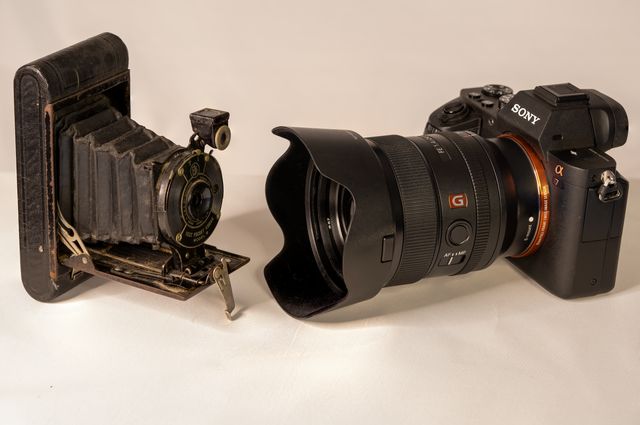
Photography has changed dramatically over the past few decades. For much of its history, taking a photograph meant exposing film, developing negatives, and printing selected images.
Digital technology changed that process almost completely.
Today, people can take high-quality photographs with dedicated cameras, smartphones, drones, and other connected devices. Images can be captured, edited, stored, shared, and published within seconds.
The evolution of digital photography is therefore not simply a story about replacing film with sensors. It is a story about how technology changed the entire photography workflow.
The Early Days of Digital Photography
The first digital imaging technologies appeared decades before digital cameras became common.
Early systems were limited by low resolution, expensive hardware, and storage constraints. Digital cameras gradually improved as image sensors became more capable and memory technology became more affordable.
Unlike film cameras, digital cameras could display images immediately. This made experimentation much easier because photographers no longer had to wait for film to be developed to discover whether a shot worked.
Digital Cameras Enter the Mainstream
During the 1990s and early 2000s, digital cameras became increasingly accessible.
Compact point-and-shoot cameras introduced digital photography to a much wider audience, while digital single-lens reflex cameras eventually became important tools for professionals and enthusiasts.
Photographers gained more control over settings such as ISO, shutter speed, white balance, and image quality while also avoiding the ongoing cost of film and processing.
|
Photography Era |
Key Technology |
Major Change |
|
Film photography |
Photographic film |
Images required chemical processing |
|
Early digital |
CCD and early CMOS sensors |
Images could be captured electronically |
|
Digital camera era |
Memory cards and LCD screens |
Immediate review and easier storage |
|
Smartphone era |
Small sensors and advanced processing |
Photography became widely accessible |
|
Computational photography |
AI-assisted image processing |
Software became central to image creation |
The Rise of CMOS Sensors
Image sensors are at the heart of digital cameras.
CCD sensors played an important role in early digital imaging, while CMOS technology eventually became dominant across many cameras and mobile devices.
Advances in sensor design improved resolution, low-light performance, speed, and power efficiency.
These improvements helped make smaller cameras increasingly capable without requiring the physical dimensions traditionally associated with professional photographic equipment.
Smartphones Change Photography
The smartphone may have had the biggest influence on everyday photography.
Instead of carrying a separate camera, people could take photographs with a device already in their pocket.
Smartphone cameras initially struggled to compete with dedicated cameras, particularly in low-light conditions and optical zoom. However, manufacturers began combining multiple lenses with increasingly sophisticated image processing.
Photography became faster, more convenient, and deeply connected to communication and social media.
Computational Photography
One of the most important developments in modern photography is computational photography.
Rather than relying entirely on the physical camera hardware, modern devices use software to process images.
A smartphone may capture multiple frames and combine them to improve dynamic range, reduce noise, enhance detail, or create a more balanced exposure.
Features such as portrait modes, night photography, HDR, panorama stitching, and automatic scene recognition all demonstrate how software has become part of the photographic process.
Artificial Intelligence and Image Processing
AI-powered tools are taking computational photography even further.
Modern cameras and editing applications can identify subjects, improve autofocus, remove unwanted objects, enhance images, and assist with editing.
These tools can make photography more accessible because users do not always need extensive technical knowledge to achieve a polished result.
At the same time, increasingly sophisticated editing raises questions about authenticity and where photography ends and image creation begins.
Editing Becomes Part of the Workflow
Digital photography also transformed post-processing.
Instead of developing film in a darkroom, photographers can edit digital files using software. Exposure, color, contrast, cropping, noise, sharpness, and many other characteristics can be adjusted without physically altering the original scene.
RAW formats provide photographers with extensive control over image data, while JPEG and other compressed formats make images easier to store and share.
Photography Becomes More Connected
Modern cameras can connect directly to smartphones, computers, cloud services, and online platforms.
Wi-Fi, Bluetooth, mobile applications, and cloud storage allow photographers to transfer and back up images quickly.
For professionals, connected workflows can also speed up the process of capturing, editing, delivering, and publishing photographs.
The Future of Digital Photography
Digital photography continues to evolve alongside advances in sensors, optics, processors, AI, and display technology.
Future cameras may become even better at capturing challenging scenes, understanding subjects, and assisting photographers during composition and editing.
However, technology does not replace the creative decisions behind a photograph. Composition, timing, perspective, lighting, and storytelling remain fundamental.
Conclusion
The evolution of digital photography has transformed nearly every stage of the photographic process.
Early digital cameras introduced electronic image capture. Improved sensors made digital cameras more capable. Smartphones made photography nearly universal, while computational photography and AI have made software a central part of image creation.
The result is a medium where hardware and software work together. Yet despite all these technological changes, the basic purpose remains the same: capturing a moment and turning it into an image.
Frequently Asked Questions
Technology can automate some technical processes, but skills such as composition, lighting, timing, and visual storytelling remain important for creating effective photographs.


Was This Article Helpful?
Click on a star to rate it!
Thank you for your vote!

Average Rating: 0/5 Votes: 0
Be the first to rate this post!

Strong engineering background in mobile and backend development. Focusing on building scalable products, improving development processes — from architecture and APIs to UX redesigns, monetization, and analytics. Responsible for applications with 1M+ downloads and multi-project ecosystems.
View LinkedIn ProfileLatest Posts

Travel Photography Tips for Stunning Memories

The Rise of Cross-Platform Gaming

Esports Arenas and the Future of Competitive Gaming